
[European Research at NSYSU] Europe in Transition: Questions from Taiwan’s Research Community
Europe in Transition: Questions from Taiwan’s Research Community
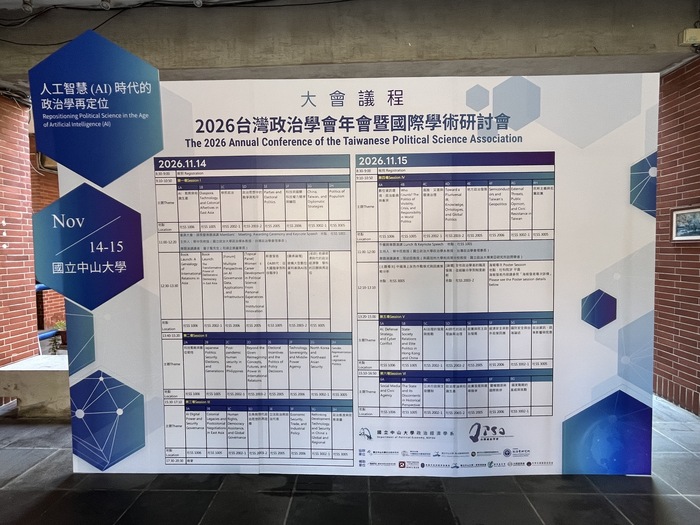
European Studies at the 2026 TPSA Annual Conference
How do online risks shape public assessments of governance? How do small states sustain security amid hybrid threats and uncertainty about alliances? And how do energy dependence, party competition and relations with major powers influence European policy choices? Seven studies featured at the 2026 annual conference of the Taiwanese Political Science Association (TPSA) approached these questions from different perspectives.
Held at National Sun Yat-sen University on 14–15 November, the conference brought together more than 400 scholars, researchers and students. It was jointly organised by TPSA and the university’s Department of Political Economy, with the EU Centre at NSYSU as a co-organiser. Its theme was “Repositioning Political Science in the Age of Artificial Intelligence.” European research appeared across panels on technology, AI governance, economic security, right-wing parties and national strategy.
The researchers featured here are 宋宜臻, a master’s student at National Cheng Kung University; 李孟瑋 and 許博喻, doctoral students at the Graduate Institute of International Politics, National Chung Hsing University; 張珈健, an assistant professor in the College of International Affairs at National Chengchi University; 蔡卓宏, a master’s student at the Graduate Institute of Political Science, National Taiwan University; 賴怡安, a 2023 graduate of the Graduate Institute of Political Science at National Sun Yat-sen University; and 譚天 of the Graduate School of Law at Tohoku University, Japan. The Centre also interviewed 譚天, 李孟瑋, 張珈健 and 蔡卓宏 about their research motivations, the new perspectives their work may offer, and the developments that deserve further attention.
Digital governance and resilience
宋宜臻, a master’s student at National Cheng Kung University, compares German public assessments of platform risks and EU protection of digital rights in 2024 and 2026. The supplied research summary reports relatively little change in perceived risks, alongside a shift in their association with evaluations of governance. It suggests that risks may initially generate demand for regulation, while persistent risks can later become a benchmark for judging performance. The data do not follow the same respondents over time, and the findings should not be generalised to the entire EU.
許博喻, a doctoral student at the Graduate Institute of International Politics, National Chung Hsing University, examines Estonia’s combination of internal resilience and external balancing in response to hybrid threats. The analysis connects continuity of government and public services with NATO, EU and regional cooperation. It highlights both the capacity to withstand and recover from disruption and the opportunities for small states to shape security agendas through institutional participation and expertise.
Policy adjustment and regional security cooperation
李孟瑋, a doctoral student at the Graduate Institute of International Politics, National Chung Hsing University, studies changes in Italy’s China policy across successive governments, asking how well “de-risking” describes the measures adopted. The supplied summary interprets the trajectory as a movement from economic engagement towards limited balancing, with governing coalitions and decision-makers’ perceptions influencing policy. The study invites closer scrutiny of the relationship between policy language and policy practice.
張珈健, an assistant professor in the College of International Affairs at National Chengchi University, examines the reorganisation of the four Nordic states’ security strategies after Russia’s war against Ukraine and under the impact of Trump 2.0. His study asks why subregional cooperation deepens even after collective defence guarantees are secured. It argues that institutions can connect defence spaces and create time and freedom of action during a crisis, directing attention to how cooperation arrangements shape the capacity to absorb shocks and organise responses.
Different responses to energy threats
蔡卓宏, a master’s student in political science at National Taiwan University, compares Poland and Hungary through alternative infrastructure, domestic political and economic interests, and political leaders’ framing of security threats. The summary’s central argument is that an external threat does not automatically produce a uniform energy policy response. Available alternatives and the political willingness to bear adjustment costs both matter.
Generations, voting and transnational party relations
The study of France by 賴怡安, an alum of the Graduate Institute of Political Science at National Sun Yat-sen University, distinguishes age effects from cohort effects using survey data from several presidential elections. The summary highlights differences between birth cohorts, without establishing that a generation’s political preferences will remain unchanged indefinitely. The research raises questions about the interaction of life stages, formative experiences and electoral contexts.
譚天, affiliated with the Graduate School of Law at Tohoku University in Japan, examines relations between China and European radical-right parties through four dimensions: perceptions, institutional behaviour, formal political exchanges, and material and interpersonal connections. The summary describes uneven development across these dimensions. Positive perceptions and individual contacts should therefore not be treated as equivalent to mature, institutionalised party cooperation.
Together, these studies offer several routes into understanding contemporary Europe. For readers in Taiwan, their comparative value begins with attention to differences in institutions, social conditions and policy choices.