變動中的歐洲,台灣學界正在研究什麼?-----2026台灣政治學會年會在中山
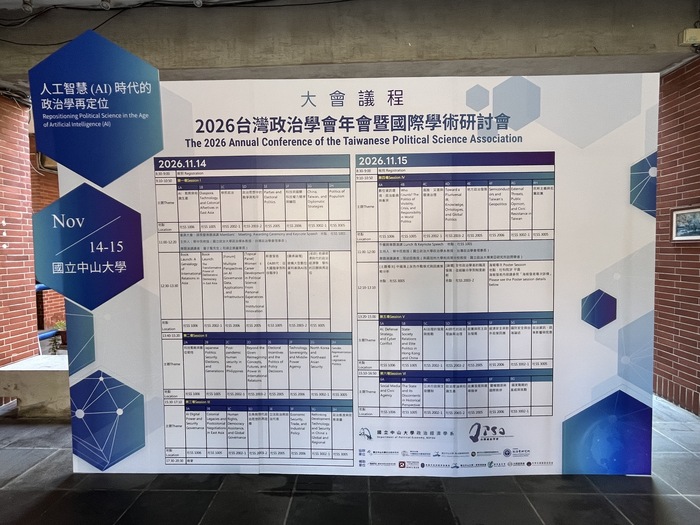
2026 台灣政治學會年會暨國際學術研討會於 11 月 14 至 15 日在國立中山大學舉行,吸引四百多位學者、研究者與學生參與;中山大學歐盟中心為本屆年會協辦單位之一。
年會由台灣政治學會與中山大學政治經濟學系共同主辦,以「人工智慧(AI)時代的政治學再定位」為主題。平台上的風險為何會改變民眾對治理的評價?小國如何在混合威脅與同盟不確定性之間維持安全?能源依賴、政黨競爭與大國關係,又如何牽動歐洲的政策選擇?本專題透過七項歐洲研究,整理值得持續追問的問題。
歐洲相關研究分布於科技戰略、AI 治理、經濟安全、右翼政黨與國家戰略等場次,呈現跨越比較政治與國際關係的研究視野。
本專題介紹的研究者包括:成功大學碩士生宋宜臻;中興大學國際政治研究所博士生李孟瑋、許博喻;國立政治大學國際事務學院助理教授張珈健;國立臺灣大學政治學研究所碩士生蔡卓宏;中山大學政治學研究所 112 級所友賴怡安;以及日本東北大學法學研究科譚天。其中,譚天、李孟瑋、張珈健與蔡卓宏另接受中心訪談,分享研究動機、研究帶來的新理解,以及值得繼續關注的發展。
數位治理如何獲得信任,小國如何維持韌性
國立成功大學碩士生宋宜臻以〈平台風險感知與數位權力評價:德國民眾對歐盟數位治理能力實證分析〉,比較德國民眾在 2024 與 2026 年對平台風險及歐盟數位權利保障的評價。依據提供的研究整理稿,兩個年度的風險感知變化有限,風險感知與治理評價的關聯卻出現轉向。研究提出一種解釋:制度建立初期,風險可能帶動治理需求;制度運作後,持續存在的風險也可能成為民眾檢視治理成效的依據。這項比較並非追蹤同一批受訪者,因此不能直接解讀為個人態度的改變,也不宜推論至整個歐盟。
國立中興大學國際政治研究所博士生許博喻以〈人工智慧時代俄羅斯混合戰威脅下愛沙尼亞之安全策略選擇:數位韌性與外部平衡〉,探討內部韌性與外部平衡如何共同回應混合威脅。研究將維持政府與公共服務核心功能的能力,連結到北約、歐盟及區域合作。其分析提醒我們,小國的安全能力也包括危機中的持續運作、調適與恢復;參與國際制度及累積專業能力,則可能使小國成為安全議題的倡議者。
大國競爭下的政策調整與區域合作
國立中興大學國際政治研究所博士生李孟瑋在〈去風險化或選邊站?美中戰略競爭下義大利的政策調整與轉向〉中,檢視義大利不同政府的對中政策,追問「去風險化」是否足以說明實際的政策轉向。研究整理稿將其策略概括為從經濟互動逐步朝有限抗衡移動,並強調執政聯盟更迭與決策者認知的作用。這項研究提供的切入點,是比較政策所使用的語言與具體措施之間的關係。
國立政治大學國際事務學院助理教授張珈健的研究〈從「北歐平衡」到北方戰略縱深:烏俄戰爭、川普 2.0 與北歐四國安全戰略重組(2022–2026)〉關注另一個問題:取得集體防衛保障之後,為何國家仍深化次區域合作?研究提出,制度合作能把不同防衛空間連結起來,為危機應對爭取時間與行動自由。北歐案例因而提供一個觀察安全的角度:地理條件之外,合作制度也影響一個社會承受衝擊與組織回應的能力。
同樣面對能源威脅,為何政策走向不同
國立臺灣大學政治學研究所碩士生蔡卓宏以〈俄羅斯能源威脅與中東歐能源政策之分歧:以波蘭與匈牙利為例〉比較兩國的能源政策,將分析焦點放在替代基礎設施、國內政治經濟利益,以及政治菁英如何界定安全威脅。依據整理稿,其核心論點是:外部威脅不會自動帶來一致的能源政策。國家可採取哪些行動,以及願意承擔多少調整成本,需要放回各自的條件與政治選擇中理解。
右翼支持的世代差異與跨國連結
國立中山大學政治學研究所 112 級所友賴怡安以〈法國選民世代之爭:2012 年後的國民聯盟再崛起〉區分年齡效應與世代效應,運用多次總統選舉民調資料,探討不同年齡與出生世代的投票選擇。整理稿指出世代差異的重要性;但這並不等於已證明任何一代選民的支持永久不變。其研究問題的價值,在於追問政治傾向如何與生命階段、成長經驗及選舉脈絡交織。
來自日本東北大學法學研究科的譚天,在〈從莫斯科到北京:中國與歐洲激進右翼政黨非自由主義連結的四維分析〉中,從認知、制度行為、正式政治交流,以及物質與人際連結四個面向,分析中國與歐洲激進右翼政黨的關係。整理稿認為,相關連結的發展並不均衡,對中國的正面認知或個別互動,不能直接等同於成熟、制度化的政黨合作。這項區分有助於避免把不同政黨與不同層次的關係化約為單一陣營。
從數位治理到安全合作,再到能源與選舉政治,這七項研究共同拓展了理解歐洲的問題範圍。它們也提供台灣讀者一個出發點:先辨識各國制度、社會與政策條件的差異,再思考比較經驗能帶來什麼啟發。
Europe in Transition: Questions from Taiwan’s Research Community
The 2026 Annual Conference of the Taiwanese Political Science Association was held at National Sun Yat-sen University on 14–15 November, bringing together more than 400 scholars, researchers and students. The European Union Centre at NSYSU was one of the conference co-organisers.
Jointly organised by TPSA and the university’s Department of Political Economy, the conference centred on “Repositioning Political Science in the Age of Artificial Intelligence.” Seven studies examined questions of online risks and governance, small-state security, energy dependence, party competition and relations with major powers.
The researchers featured here are 宋宜臻, a master’s student at National Cheng Kung University; 李孟瑋 and 許博喻, doctoral students at the Graduate Institute of International Politics, National Chung Hsing University; 張珈健, an assistant professor in the College of International Affairs at National Chengchi University; 蔡卓宏, a master’s student at the Graduate Institute of Political Science, National Taiwan University; 賴怡安, a 2023 graduate of the Graduate Institute of Political Science at National Sun Yat-sen University; and 譚天 of the Graduate School of Law at Tohoku University, Japan. The Centre also interviewed 譚天, 李孟瑋, 張珈健 and 蔡卓宏 about their research motivations and the developments that deserve further attention.
Digital governance and resilience
宋宜臻, a master’s student at National Cheng Kung University, compares German public assessments of platform risks and EU protection of digital rights in 2024 and 2026. The supplied research summary reports relatively little change in perceived risks, alongside a shift in their association with evaluations of governance. It suggests that risks may initially generate demand for regulation, while persistent risks can later become a benchmark for judging performance. The data do not follow the same respondents over time, and the findings should not be generalised to the entire EU.
許博喻, a doctoral student at the Graduate Institute of International Politics, National Chung Hsing University, examines Estonia’s combination of internal resilience and external balancing in response to hybrid threats. The analysis connects continuity of government and public services with NATO, EU and regional cooperation. It highlights both the capacity to withstand and recover from disruption and the opportunities for small states to shape security agendas through institutional participation and expertise.
Policy adjustment and regional security cooperation
李孟瑋, a doctoral student at the Graduate Institute of International Politics, National Chung Hsing University, studies changes in Italy’s China policy across successive governments, asking how well “de-risking” describes the measures adopted. The supplied summary interprets the trajectory as a movement from economic engagement towards limited balancing, with governing coalitions and decision-makers’ perceptions influencing policy. The study invites closer scrutiny of the relationship between policy language and policy practice.
張珈健, an assistant professor in the College of International Affairs at National Chengchi University, examines the reorganisation of the four Nordic states’ security strategies after Russia’s war against Ukraine and under the impact of Trump 2.0. His study asks why subregional cooperation deepens even after collective defence guarantees are secured. It argues that institutions can connect defence spaces and create time and freedom of action during a crisis, directing attention to how cooperation arrangements shape the capacity to absorb shocks and organise responses.
Different responses to energy threats
蔡卓宏, a master’s student in political science at National Taiwan University, compares Poland and Hungary through alternative infrastructure, domestic political and economic interests, and political leaders’ framing of security threats. The summary’s central argument is that an external threat does not automatically produce a uniform energy policy response. Available alternatives and the political willingness to bear adjustment costs both matter.
Generations, voting and transnational party relations
The study of France by 賴怡安, an alum of the Graduate Institute of Political Science at National Sun Yat-sen University, distinguishes age effects from cohort effects using survey data from several presidential elections. The summary highlights differences between birth cohorts, without establishing that a generation’s political preferences will remain unchanged indefinitely. The research raises questions about the interaction of life stages, formative experiences and electoral contexts.
譚天, affiliated with the Graduate School of Law at Tohoku University in Japan, examines relations between China and European radical-right parties through four dimensions: perceptions, institutional behaviour, formal political exchanges, and material and interpersonal connections. The summary describes uneven development across these dimensions. Positive perceptions and individual contacts should therefore not be treated as equivalent to mature, institutionalised party cooperation.
Together, these studies offer several routes into understanding contemporary Europe. For readers in Taiwan, their comparative value begins with attention to differences in institutions, social conditions and policy choices.
系列預告:中心將在官網、Facebook 與 Instagram 陸續推出系列研究報導與訪談內容,敬請持續關注。
Coming next: Further research features and interview content will be released on the Centre’s website, Facebook and Instagram.